Showing posts with label Featured Plants. Show all posts

Sunday, April 15, 2012

How Do You Like Your Lilac?

Syringa (Lilac) Bloomerang
This is Syringa (Lilac) Bloomerang.  When it was introduced by Proven Winners (I'm sure you've seen their plant tags) a few years ago, there was a huge kerfuffle.  Bloomerang is a reblooming lilac.  What's that you say?  Yes, it's true--and it made some people mad.  There are the purists who look forward to lilac's bloom with great anticipation--and they appreciate it all the more because it is fleeting.  They believe that a reblooming lilac ruins what's so special about it in the first place.  Me, I'm not worried about violating some tenet of a hardcore horticulturalist.  The space in my container garden is at a premium and I can't afford to be so principled.  And yes, I have Hydrangea "Endless Summer" (though I also have traditional mophead) and "Knockout" roses (along side a couple of David Austins). 

Lilac buds

This is my lilac's 3rd season in my garden.  The first year, it didn't do much.  Last year it bloomed wonderfully but I did not deadhead the spent blooms so I never got repeat blooms.  This year I'll trim off the blooms and see if there really is truth in advertising. 

Bloomerang is hardy to zone 4, grows 4 to 5 feet tall, and likes full sun.  It's very fragrant and mildew resistant.  I have mine in a pot that is 18" high and 18" in diameter.


Lilac in bloom

As far as I'm concerned, Bloomerang can bloom as much and as often as it wants, for as long as it wants.  Who am I to argue?

Saturday, April 7, 2012

First Project of the Season

Seed packets (Buy at grocery, nursery, or online)
I've decided that I want a little more food in my container garden this year so last weekend, I planted lettuce.  Here's what I did:  (1)  I got a wooden wine box from the small grocery store that I visit often.  It probably helps that I had a full cart of paid-for groceries when I asked the manager for it.  You'd think a wine box would be easy to get your hands on but I've had stores that I'm positive get lots of them tell me "no" when I've asked for one. I'm not sure what they do with theirs but maybe it's no coincidence that these boxes can be found (for a price) on eBay. (2) I drilled holes for drainage.  Please wear goggles. (3) I bought different types of lettuce seeds.  (4) I filled the box with potting soil and added some Osmocote timed release fertilizer. (5) I planted the seeds.  They are teeny tiny so you barely have to press them into the soil.  Then sprinkle the soil with water.  Don't overdo the water part. (6) I check the box every 15 minutes to see if anything has sprouted.  So here are some pictures and I'll keep you posted on the progress.

Wooden wine box

Drilled holes (Wear goggles!)

Seedlings after one week

Don't forget to label!


Saturday, March 24, 2012

Welcome to Spring!

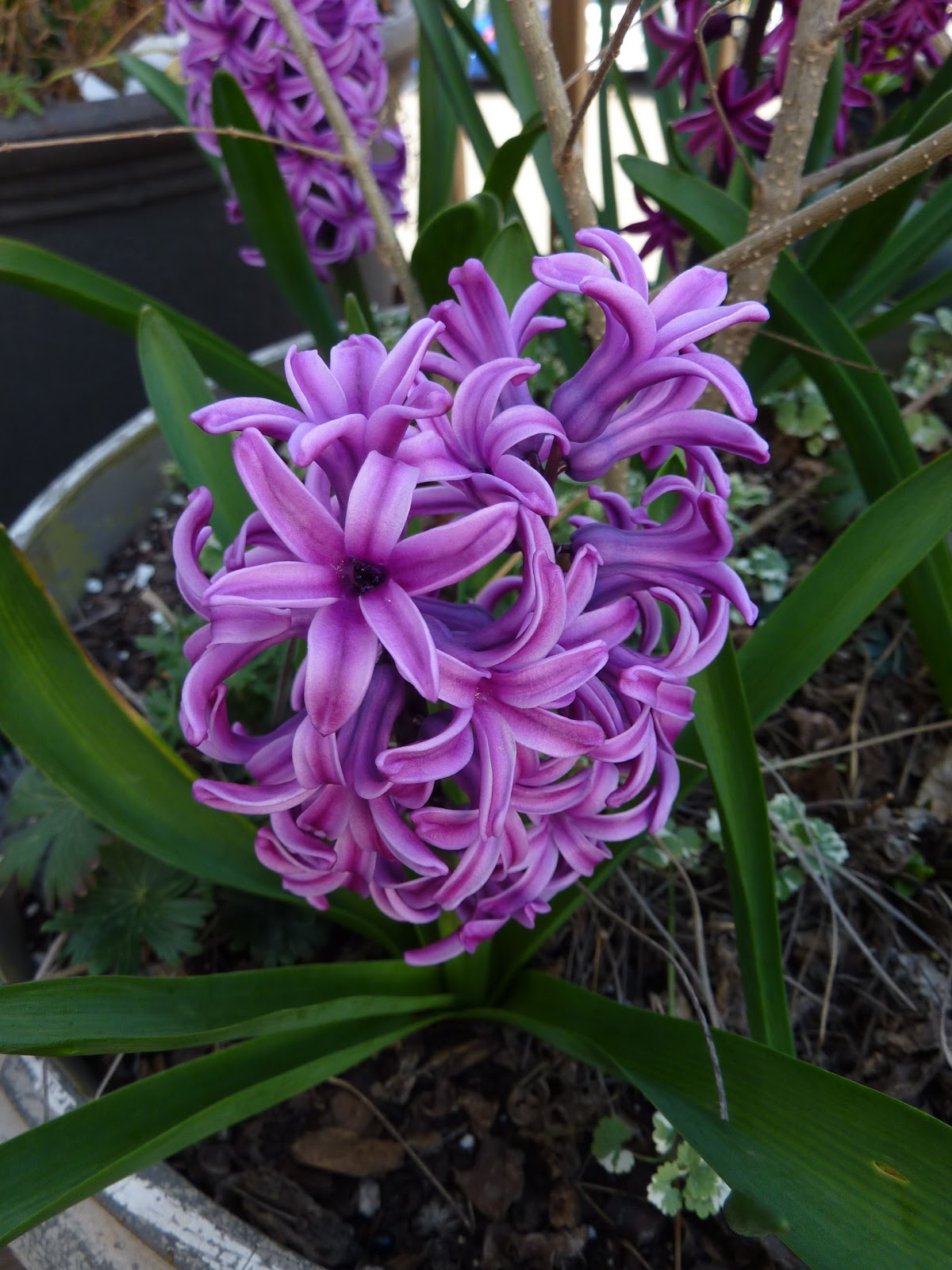
Hyacinth
The first signs of spring emerged much earlier than I (or almost anyone else) expected.  In fact, our winter here was so mild that I had several plants in containers that never fully died back.  And our recent warm temperatures have been the focus of many a gardening article and news segment. 

For me, one of the most delightful signs of spring is the blooming of hyacinths and daffodils.  Here is one of the many hyacinth that I planted in my containers two years ago.  The color is so vibrant and the fragrance is amazing. Hyacinth comes in bulb form and should be planted in the fall along with your daffodils and tulips.  And as the photo shows, they do perfectly well in containers but I recommend that they be planted in a rather large container because small ones might not offer enough winter protection for the bulb.

I intend to begin my weekly postings now that the season is getting into gear.  I'll have new plants to show, new books to recommend, and I hope to add more food to my container garden this year. 

Bookshelf:  Container Gardening Books

Sunday, January 15, 2012

Off to a Good Start

Amaryllis in bloom
A slightly belated Happy New Year!  I normally don't post in the dead of winter but this is something worth sharing.  My amaryllis have bloomed and they look terrific.  Unfortunately, I did not keep the tags for these bulbs so I can't provide their exact names.  I bought them at my not-so-local nursery.  They sell lots of varieties--some more exotic than others.  But if you want just basic white or bright red blooms, you can usually find them at your local big box stores beginning late October. 

Amaryllis take a little longer to get to the blooming stage than paperwhites.  Usually you can count 3 weeks from the time you plant a paperwhite to the time it blooms.  With amaryllis, it's more like 5 or 6 weeks.  Which explains why I never have blooms before Christmas because I never remember to plant the amaryllis that far in advance.  But I'll try to be more on the ball this year and I'll put together a little photo tutorial.

I'll return to weekly (or more) posts beginning in March when I start making preparations and placing orders for this season's garden.  Meanwhile, if you're in a cold place, keep warm this winter.  And if you're in a warm place, all I can say is, lucky you.

Amaryllis in bloom and paperwhites sprouting


Bookshelf:  Container Gardening Books

Sunday, December 11, 2011

Don't Let the Cold Weather Stop You

Blooming Paperwhite Narcissus


Loose Paperwhite bulbs


There may be a chill outside but that doesn't mean you can't plant some flowers indoors.  The solution:  Paperwhites.  I have posted on this topic a few times in winters past.  This is so easy that I can't think of any reason on earth why you wouldn't want to do it.  I'm going to recap the main steps here, but for more pictures, you can go to my previous posts:  Winter Blooms and Flowers in Winter. 

1)  In many of the discount chain stores, you'll see paperwhites in kits.  You can buy those, but I like using my own containers so I buy my bulbs loose at my local big box store or nursery.  You decide what you prefer.  More than likely, the label will say something like Paperwhite "Ziva". 

Paperwhites planted in rocks and water

2)  Put soil or rocks in a container.  For once, you will not need (or want) drainage holes in your container.
3)  If using soil, dampen it a bit but don't soak it.  If using rocks, bring the water level up to the top level of the rocks.
4)  Place bulbs root-side down on damp soil or, if using rocks, on the surface of the rocks so that a little water comes in contact with the roots.

Paperwhites sprouting in soil

5)  Put container indoors in any place where it will get at least medium light.
6)  Keep soil damp (not wet) or water level of rocks in contact with bulb roots.
7) Wait about 3 weeks for stems to start growing and blooms to appear.

Be aware that most paperwhites will have a scent.  Some people love it (me), some people hate it (the husband of the lady who I encountered at the nursery a couple of years ago).  My local nursery started stocking individual bulbs that produce unscented blooms. 

I have more to say about bulbs in winter, but I'll talk about that in future posts.
Close up of Paperwhite blooms


Sunday, November 20, 2011

Last Days of Mandevilla

Mandevilla
It's great to still have new blooms (and buds) on this plant so late in the year.  This is Mandevilla and it's a tropical (and subtropical) flowering vine that is native to Central and South America.  In my zone, it's an annual.  I plant it every year because it adds vertical interest to a container garden.  You do have to grow it on some type of structure--mine is on a wire trellis that's about 5 feet high.  I plant mandevilla every spring once the night time temperatures are consistently above 55F.

You'll typically find mandevilla with white blooms, red blooms, or pink blooms.  It requires full sun and plenty of water.  It grows super fast and does not require any maintenance on my part. 

I know that people successfully overwinter mandevilla by putting it in a garage or a laundry room that gets some light.  I have a friend in Pennsylvania whose mandevilla is on its 7th year. But my garage has no window and I don't have a laundry room to speak of.  Plus I don't have a lot of extra space to be storing plants indoors so I buy a new plant every year. 

Check out one of my earlier mandevilla posts (from 2008) to read about my planting technique and be sure to add this plant to your shopping list in the spring.

Bookshelf:  Container Gardening Books

Saturday, November 12, 2011

Herbs Still Going Strong

Purple Sage


It's November and many of my herbs still look fantastic.  I always grow lots of herbs.  I do a decent amount of cooking and there's nothing like going right out onto the deck and clipping a few herbs for a marinade or a pasta sauce.  Also, I like how they make such great companions in a mixed container planting (oregano notwithstanding--it's terribly invasive).  So here are three that are still going strong.

Sage:  This is an old standby for me.  It's perennial in my zone so it returns every year.  I'm partial to purple sage because it plays well with bright colors in a container.  Also, the texture of the leaves adds interest to a mixed planting.  It likes full sun.  For cooking, it's a great addition to pork, turkey, and even cheese dishes.  I always put a few leaves under the skin of my Thanksgiving turkey before I roast it.  But be careful not to use too much as it can be overpowering.


Italian Parsley

Parsley:  I grow flat leaf (Italian) parsley.  What's the difference between that and curly parsley?  Well, I think the flat leaf just looks better, more elegant, in the garden.  Also, most cooks prefer flat because it's more pungent.  Typically you would only see curly parsley as a garnish.  Parsley is a prolific grower and likes full sun.  Although I've read about gardeners in colder zones than mine having luck with their parsley returning, mine has never survived my zone 7 winter.  I have to buy new every year.  Because there's even more flavor in the stems than in the leaves, I just chop up an entire bunch, stems and all, into my marinades and pasta sauces.  Also, consider adding parsley to your salad. 

Thyme:  This herb is super easy to grow.  You can start it from cuttings with almost no effort.  It is very hardy (zone 4) and likes full sun.  Because its leaves are so tiny, it is a great addition to a mixed planting and it tends to have a spillover effect.  For cooking, try it in your marinades, meat dishes, soups, and stuffing. 

Thyme
My most favorite herb, Rosemary, is missing from this writeup.  For whatever reason, it did not perform well for me this year, and I had three plants!  I usually have great success with it but this year, I think I'll barely have enough for my Turkey Day preparations.  Oh well, better luck next year!

Saturday, November 5, 2011

Maybe with a Little Imagination....


Cuphea "Tiny Mice" or "Bat Face"

...you'll be able to see why this plant is nicknamed "Tiny Mice" and "Bat Face".  Its official name is Cuphea (phonetically:  kew-FAY-uh).  Click to enlarge the picture to the left and maybe, if you sort of squint, and look a little sideways, you can see that it somewhat resembles the face of a bat (although I've never been nose to nose with a real bat, and don't hope to be, so I can't say for sure).  Or you might view the little red petals on each side as the ears of mouse and the purple part, the face. 

Cuphea "Tiny Mice/Bat Face"

All likenesses aside, I think this is a nice plant to have in the garden because its tubular shape is so different than most flowers you might already have.  Also, it attracts hummingbirds.  I've only seen a hummingbird a few times this season, but that doesn't mean it doesn't visit with more frequency when I'm not looking.

Cuphea likes part to full sun, is heat tolerant, grows to a height of about 10 inches, and it's only hardy to zone 8.  So I will have to buy another one if I want it in my garden next year.  It blooms from spring to frost so even though you'll only have it for one season, you will definitely get your money's worth.  I have mine planted in a small terracotta pot along with only one other plant:  a creeping wire vine.

Bookshelf:  Container Gardening Books

Sunday, October 30, 2011

Premiere Performance

Blush Euphorbia close up
This is the first year I've grown this plant.  It's called Blush Euphorbia.  It's a dainty little plant with all of these delicate blooms all over it.  And it blooms like crazy all summer long.  It has dark green leaves with tones of burgundy and red.  I have found it to be a fantastic "filler" plant for a container.  Unfortunately, it is not perennial in my zone but that's okay, it's going right back on my shopping list for next spring. 


Blush Euphorbia likes full sun, is heat tolerant, and grows to about 12 inches high.  I think it would be a great filler in almost any mixed container planting.  Maybe next year I'll put it with a plant that only produces foliage, like heuchera.  
Blush Euphorbia


 I read that Blush Euphorbia was recognized for Excellent Container Performance in 2010 at the University of Colorado.  I wholeheartedly agree with that honor.


Wednesday, October 26, 2011

Strawberries in October?


Strawberries in October
 It was quite a surprise to see these yesterday.  I'm not sure we'll have enough warm days left for these guys to ripen, but it sure would be nice to have strawberries this late in the year.

Bookshelf:  Container Gardening Books

Monday, October 10, 2011

Geranium

Geranium (Annual)
Even though I add more perennials to my garden each year, I always leave plenty of space for annuals.  Here's why:  Annuals provide a constant burst of color all season long.  They bloom and bloom again--they give it their all until the end of the season when they expire from sheer exhaustion.  They don't come back the following year (at least not in my zone) so if I want the same show, I have to go out and buy new the next season.  When you combine annuals and perennials in the same container, you are virtually guaranteed that something interesting will be going on the entire season.  You can count on the perennials returning next year (make sure they are hardy in your zone) and you can change things up by filling the space left by the previous year's annual with a different type of annual.

Here's one of my favorite types of annuals, the geranium.  I tend to avoid the traditional geranium colors like white and red.  Although those, planted in quantity, can make quite a statement.  I lean towards colors like this one and I especially like the variegation.  I don't know the name of this geranium because it didn't come with a plant tag.  I have it planted in a container with herbs--sage and thyme--both of which are perennial.

Bookshelf:  Container Gardening Books

Sunday, October 2, 2011

Blades of Grass


Variety is what makes a garden interesting.  I love having different types of grasses in my container garden.  I have one container with Purple Fountain Grass, another with Karl Foerster Feather Reed Grass, and an iron urn planted with this--Hakonechloa.  I've had this plant in the same urn for about 4 years.  It's a native of Japan and is perennial to zone 5 so I've been able to rely on its return every year.  It gets full morning sun in my garden which brings out the golden color of the blades.  It grows to about 18" tall and has a cascading habit that is wonderful, but it gets even better when a breeze comes through. 

Who says you need to have flowers in a container garden?  I could see getting a few different grasses (or even several of the same type), planting them in fantastic containers, strategically positioning them on your deck or having them flank your front entry, and then calling it a day. 

Bookshelf:  Container Gardening Books

Sunday, September 25, 2011

Remember That Blackberry Lily?


Belamcanda "Blackberry Lily" seed pod

Belamcanda "Blackberry Lily" bloom
Belamcanda seed pods

In mid-July, I wrote a post featuring Belamcanda, or "Blackberry Lily".  I talked about how after the bloom fades, a seed pod forms and then it later breaks open revealing something that looks very much like a blackberry.  Well, here it is.  Cool, huh?

Bookshelf:  Container Gardening Books

Sunday, September 11, 2011

Rozanne and Margarita

Rozanne and Margarita
This is the color combination that I tend to repeat most often:  purple and lime green.  Here I did it with Geranium "Rozanne", a perennial that is hardy to zone 5, likes partial to full sun, and blooms all season long.  For the lime green I used Sweet Potato Vine "Margarita", an annual that is well worth buying every year because of its fantastic trailing habit.  (For more evidence, check out my link from last August.)  To the right of the picture, you'll see a bronze colored leaf as well.  That's from Sweet Potato Vine "Sweet Caroline".

Feel free to comment with color combinations that you like to put together.  I'm always looking for new ideas.

Bookshelf:  Container Gardening Books

Monday, September 5, 2011

Summer Heat

A little summer heat
As if summer all over the country has not been hot enough, here's something to add a little extra spice to that heat.  Although this pepper plant did not come with a tag, I'm 99% sure it's a Serrano pepper.  Serranos are pretty hot, in fact, they are 5 times hotter than a Jalapeno.  The heat of chili peppers is measured in Scoville heat units (named after a chemist by the name of Wilber L. Scoville).  A sweet bell pepper comes in at 0 on the scale; a Serrano is anywhere from 8,000 to 22,000; a Red Savina Habanero registers up to 575,000; and the grand daddy of them all, the Trinidad Scorpion, can reach a whopping 1.4 million.  Someone call the fire department!

The degree of heat of a particular pepper depends on the growing conditions, the soil, and the weather.  So the range for the Serrano can be explained by those factors.  Also, Serranos will change color on the stalk depending on how long you leave them there.  Mine turn red but others might turn brown, orange, or yellow.  I use mine mostly to make salsa, along with tomatillos that I also grow.  If you need to turn down the heat a little, you can always remove more of the seeds and the membrane from inside the pepper--that's where most of the heat is. 

If you've gotten in over your head, heatwise, there are a few ways to get immediate relief.  Some proven remedies are:  drink milk; drink sugar water; drink alcohol.  Some folk remedies are: eat cucumber slices; eat a raw carrot; and, get this, eat more of the same pepper (really??).

Hot peppers are annual in my zone so I'll have to replant if I want more next year.  Also, they like full sun and you can easily grow them as a companion plant in a mixed container. 

Bookshelf:  Container Gardening Books

Saturday, August 27, 2011

Changing Hydrangea


Changing Hydrangea
 
Try saying that 3 times fast!  This is one of the Endless Summer hydrangeas that I bought about 3 years ago.  It bloomed so well this season and I even cut a bunch of blooms earlier in the summer to put in the house.  At that time of year, they were pink.  But as summer wanes, the blooms start to change.  They take on a sort of dried look and I think it adds some interest to a late season garden. 

As I mentioned, the blooms were pink.  I tried to change the color to blue by acidifying the soil using a garden sulfur product by Espoma (it can be found in any big box store or garden center).  I think I did not apply enough or with enough frequency.  I think maybe the latter because I water every day so anything in the soil washes out fairly quickly.  I'll try again next year.

On to the subject of pruning.  Here's what I do:  Nothing.  Endless Summer blooms on old wood and on new wood.  Old wood refers to the stems that have been on the plant since last summer.  New wood refers to the stems that developed this season and that continue to produce buds through the fall.  If you cut back those, you know what happens.  No buds this year equals no flowers next year.  So why cut back any of it?  The only stems you really need to trim are any dead ones.

Finally, fertilizers.  I only use a slow release fertilizer at the beginning of the season.  If you fertilize too much, you'll get lots of pretty foliage but few blooms.  So as far as fertilizers go, less is more.

Hydrangeas make a great container plant.  You just need to make sure you have a large enough pot because it will definitely multiply in size every year.  

Bookshelf:  Container Gardening Books 

Sunday, August 21, 2011

The Name of the Rose

Mini rose
Actually, I wish I did know this rose's name, but I don't.  I bought it last year at our local big box store.  As is sometimes the case, it had a plant tag with very sketchy information.  I didn't keep the tag but if I remember correctly, it read something like, "Mini-rose, plant in full sun."  It overwintered just fine and has bloomed sporadically all season long.  It also seems to get along well with others because I have it in a container with Gaura and Ajuga.  It's been a nice addition to my garden, but it will remain nameless.

Bookshelf:  Container Gardening Books

Sunday, August 7, 2011

Pretty Plumes

Astilbe
I like having plants with interesting blooms in my container garden.  Here's one:  Astilbe.  It has feathery plume-like flowers and they bloom on an upright growing plant.  There are different varieties so you can find some that grow only a foot high and others that grow as tall as 4 or 5 feet.  I don't know the name of this particular astible because it was given to me by another gardener who was dividing her perennials a couple of years ago.  This plant adapted quickly to its container and bloomed the first season that I had it.

Astilbe is a perennial that is hardy to zone 4.  It can tolerate full sun, but it's best to give it a little shade, otherwise you risk scorching the leaves.  This plant bloomed for me in June.  I bring it to your attention now because soon, the garden centers and big box stores put their perennials on sale.  That's a good time to buy some new plants.  Don't be afraid of the ones that look a little unloved.  They often bounce back in time.

You can go ahead and plant perennials in your containers and they should survive the winter if they are suitable for your hardiness zone.  But remember, my rule of thumb is that for containers, subtract 2 from your region's planting zone.  This is because when a plant is in a container, it is more exposed to the elements than when it is in the ground.  Where I am in Northern Virginia, my hardiness zone is 7.  So I look for perennials with a hardiness zone of 5 (or lower).  Also, make sure you don't plant in too small a container.  The more insulated a plant is by soil, the better chance it will have of surviving.

Bookshelf:  Container Gardening Books    
Saturday, July 30, 2011

Growth Spurt


Graham Thomas growth spurt


Graham Thomas blooms
 My Graham Thomas rose is three years old and it's been growing pretty much at a snail's pace.  It has produced more blooms every year, mostly in the late May/early June timeframe.  After that, it blooms sporadically throughout the rest of the season.  But a couple of weeks ago, it had a tremendous growth spurt--well, one stem did anyway. 

This particular rose is supposed to grow up to 8 feet high.  It loves the sun and is hardy to zone 5.  I do absolutely nothing to it all year long other than add some time release fertilizer at the beginning of the season.  Maybe if I fussed a bit more, I'd have more uniform growth but that's not the kind of gardener I am. 

When I ordered Graham Thomas, I was told I could train it as a climber.  I'm having some difficulty doing that since it has such an upright growth habit, but I'm not giving up yet.  Meanwhile, I'll just enjoy these little surprises when they happen.

Bookshelf:  Container Gardening Books

Saturday, July 16, 2011

But It Doesn't Look Like Fruit

Belamcanda "Blackberry Lily"

Belamcanda "Blackberry Lily" Bloom
The common name for this plant is Blackberry Lily.  It's official name is Belamcanda Chinensis and it is native to China and Japan.  It's called Blackberry Lily because in late summer, the seed pod dries and breaks open, revealing a blackberry-like seed cluster.  It's pretty cool and can be used in dried flower arrangements.

Even though it has the name lily, it's really part of the iris family.  You can tell by the fan-shaped leaves.  Belamcanda grows to about 3 feet and is hardy to zone 5.  It blooms mid-summer and requires no special treatment.  I think it is useful as a focal point of a mixed container so you could plant some shorter, fuller plants around it, some sort of Heuchera would be good.  I'd also plant something that spills over the edge of the pot--maybe something like Calibrachoa with a bloom color that complements the bloom of the Belamcanda. 

I think Belamcanda is an interesting plant with an unusual bloom so it will definitely remain a permanent part of my container garden.  I also like the fact that the blackberry looking seed pods add interest to a winter garden.  Just don't eat them!

Bookshelf:  Container Gardening Books